
Plan a Private Home Sale Without Realtor Fees
Plan a private Canadian home sale by defining responsibilities, budgeting non-commission costs, preparing the listing, handling offers and closing safely.

A responsibility-first Canadian seller guide
Plan a Private Home Sale Without Realtor Fees
Short answer. You can explore selling without hiring a listing realtor, but that does not make the sale cost-free or remove legal, tax, mortgage and transaction responsibilities. Before listing, assign pricing, marketing, inquiries, identity checks, showings, disclosures, offers, conditions, deposits, legal work and closing. Build a budget for every non-commission cost and hire qualified help wherever your province, property or risk requires it.

Selling without a listing realtor changes who performs the work; it does not remove the work or every cost.
Decide whether a private home sale fits you
A private sale may fit an owner who has time, a clear property file, confidence communicating with buyers and a plan for professional legal and tax work. It may be a poor fit when title is complicated, owners disagree, the property has unusual use or defects, a sale is urgent, the owner is absent, or the seller expects a platform to replace individualized advice.
Write a responsibility map before choosing. Who will research the asking range, prepare the property, take accurate photos, draft the listing, answer inquiries, screen viewing requests, protect occupants, collect feedback, compare offers, manage conditions and coordinate closing? “The website handles it” is not a sufficient answer unless current terms assign that task explicitly.
Houseup's current homepage presents a property-listing marketplace, direct buyer connections and access to professionals. Treat those as a starting interface. Verify current eligibility, features, fees, listing distribution, identity processes, support and legal boundaries before relying on them.
Budget more than realtor commission
“Without realtor fees” commonly means the seller does not retain a listing realtor under a commission agreement. It does not establish that no real-estate professional will be involved or that no other payment could arise. A buyer may have representation, and the parties' agreements and local rules matter.
The Financial Consumer Agency of Canada's home-selling guide lists standard and potential selling costs, including legal services, mortgage discharge, repairs, inspections, appraisal, moving, staging, cleaning and mortgage prepayment penalties. Build a property-specific budget rather than subtracting a guessed commission from the sale price.
| Budget line | What to confirm | Who can verify it |
|---|---|---|
| Legal closing | Review, title, adjustments, discharge, registration and closing scope | Qualified local lawyer or notary |
| Mortgage | Balance, discharge fee, prepayment penalty and portable options | Current lender statement |
| Tax | Principal residence, rental or business use and reporting | CRA guidance and tax professional |
| Property preparation | Repairs, cleaning, staging, storage and moving | Written provider quotes |
| Marketing | Photography, floor plan, signage, platform and advertising | Current terms and quotes |
| Transaction support | Inspection, appraisal, condominium documents or certificates | Applicable professionals and property records |
| Contingency | Owner-approved changes and unresolved property issues | Seller's documented plan |
The Canada Revenue Agency's current principal-residence guidance explains reporting and qualification rules. Do not assume a principal residence sale has no reporting requirement or that every gain is exempt.
Prepare the property file before the listing
Gather title and ownership information, mortgage details, tax records, survey or plans, permits, renovation records, warranties, utility information, rental or tenancy documents, condominium records where applicable, and known property issues. Ask a qualified local legal professional which documents and disclosures apply; requirements differ across Canada.
Set an evidence-based asking strategy. Compare current competing listings and recent relevant sales where reliable data is available. Consider a professional appraisal when the property or market makes self-pricing weak. A high price can reduce interest, while a low price can create risk; neither outcome should be promised.
Create an accurate listing packet with current photos, dimensions identified by source, included and excluded items, occupancy, showing process and contact path. Do not claim a feature, zoning, permit, school, boundary, rental income or development potential unless you can substantiate it and may lawfully publish it.
Houseup currently provides a property-listing destination. Review the current fields, privacy treatment, moderation, distribution and edit controls before uploading personal or property information. Avoid showing alarm details, valuables, family schedules or documents containing signatures and account numbers.
Build a safe inquiry and showing process
Decide who receives messages, which information is public and how prospective buyers request a viewing. Use one log for inquiry name, contact, source, requested time, confirmation and follow-up. Do not assume an account badge or message proves identity, financing or intent.
Create viewing rules for occupied homes: protect pets, medications, mail, keys, devices and personal records; avoid one-on-one situations that feel unsafe; and record who attended. Consider appropriate professional support. Follow applicable privacy and human-rights requirements when collecting information or screening requests.
Prepare consistent answers for property facts and direct legal, tax, financing or technical questions to the appropriate professional. If you do not know an answer, say so and investigate rather than guessing. Keep material representations and corrections in writing.
Houseup also publishes a professional directory. A listing is a discovery aid, not verification. Independently check identity, licence where applicable, insurance, scope, conflicts, fees and terms before hiring anyone.
Plan offer review, conditions and closing handoffs
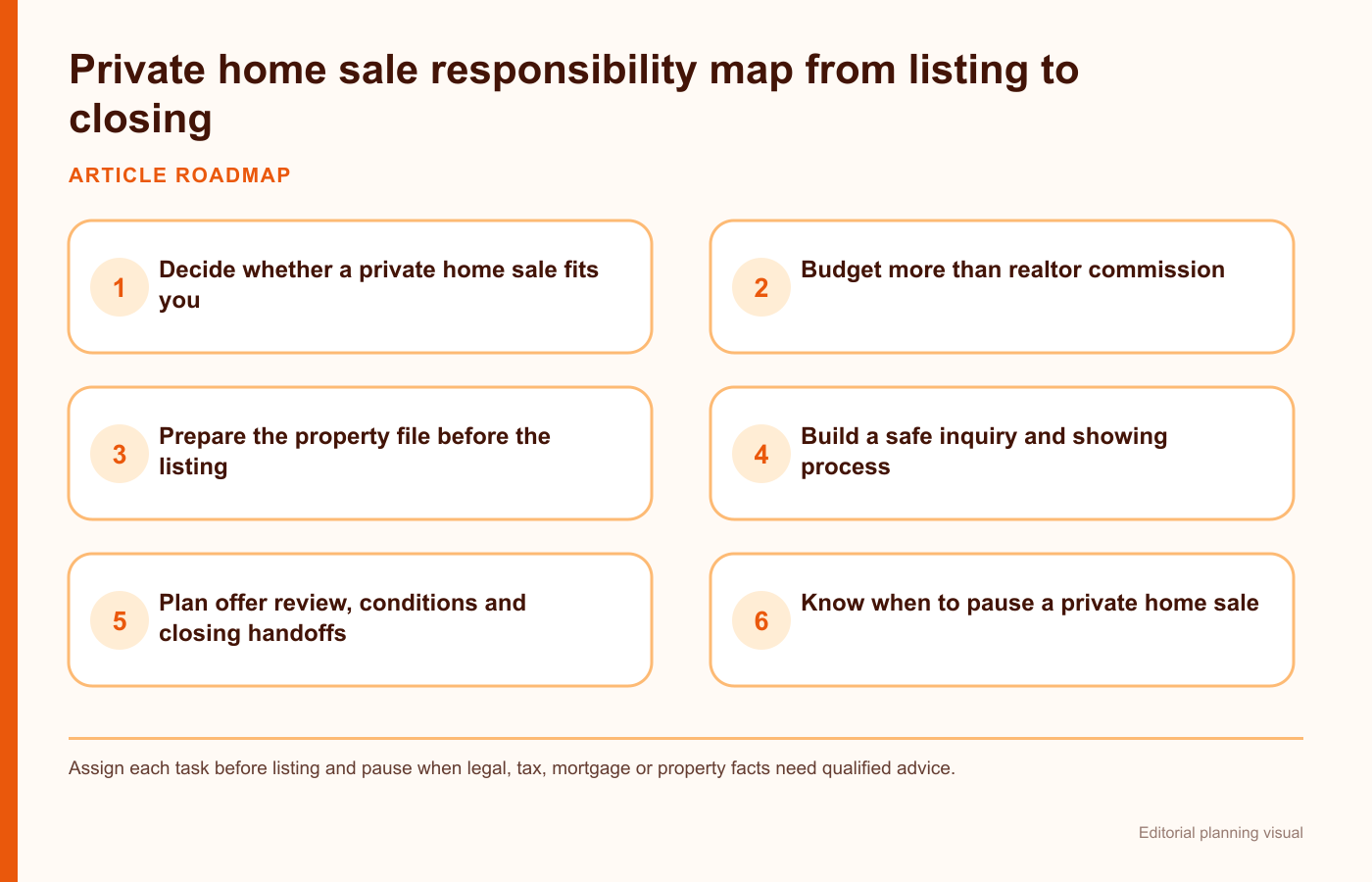
Assign each task before listing and pause when legal, tax, mortgage or property facts need qualified advice.
An offer is more than price. Closing date, deposit, financing, inspection, sale-of-property and other conditions, included items, adjustments, representations and remedies can change value and risk. Use a qualified local legal professional before signing or countering, not after an agreement becomes binding.
- Confirm the buyer and representative contact information.
- Send the complete written offer to your legal advisor.
- Compare net terms and conditions, not price alone.
- Record every counteroffer and expiry without informal side agreements.
- Follow professional instructions for deposits; do not improvise custody.
- Track condition dates, notices and amendments.
- Coordinate lender discharge and required property documents.
- Prepare adjustments, keys, access and included-item confirmation.
- Report the sale and address tax obligations with qualified advice.
The Law Society of Ontario provides a directory and referral information for legal professionals. Sellers outside Ontario should use the regulator and professionals for their province or territory.
Know when to pause a private home sale
- Ownership, title, estate, separation or authority to sell is unclear.
- The property has tenants, business use, short-term rental use or tax complexity.
- Unpermitted work, contamination, boundary, structural or disclosure questions arise.
- A buyer or representative applies pressure to sign immediately.
- Deposit instructions, identity or payment communications change unexpectedly.
- The offer uses unfamiliar terms or removes expected conditions.
- Platform features or support do not match the current terms.
- You cannot manage inquiries and showings safely or consistently.
Pausing does not mean the private-sale option failed. It means the issue needs the right evidence or professional. A seller can use a lawyer, appraiser, inspector, photographer, tax advisor or other specialist without handing every task to one representative.
Common private home sale planning mistakes
- Equating no listing commission with no selling costs
- Listing before title, mortgage and tax questions are reviewed
- Pricing from active listings alone or an automated estimate
- Publishing unsupported property, zoning or income claims
- Assuming a platform verifies every user or professional
- Hosting showings without a privacy and safety process
- Comparing offers by price while ignoring conditions and dates
- Letting an unverified party handle deposits or sensitive documents
- Seeking legal review only after signing
Frequently asked questions
Can I sell a home in Canada without a realtor?
Private sales are possible, but provincial and territorial law, property facts and transaction structure determine the process. Obtain qualified legal and tax advice and assign every seller responsibility.
Does selling privately mean there are no realtor fees?
It may avoid a listing-realtor commission if no such agreement exists, but buyer representation and other arrangements can affect payments. Confirm the actual contracts and local practice.
Do I still need a lawyer or notary?
Legal closing and representation requirements vary by jurisdiction and transaction. Use the appropriate regulator to find a qualified professional and engage them early.
How much can I save by selling privately?
No responsible amount can be promised without the commission arrangement, sale price, marketing, legal, mortgage, tax, preparation and transaction costs. Compare full net scenarios.
Choose a practical private-sale next step
Complete the responsibility map and full-cost budget before publishing a listing. Review Houseup's current terms and use its contact page to confirm eligibility, features, fees, privacy, support and platform boundaries. Then have the property, legal, tax and mortgage plan reviewed by qualified local professionals before accepting an offer.