
What Really Happens When You Sell Your Home Online
Understand the roles, decisions and limits involved when selling your home online, from property facts and marketing to offers and legal closing.

What Really Happens When You Sell Your Home Online
Putting a property online is a publishing action. Selling it is a legal and financial transaction. Between those points are property facts, representation choices, marketing approval, inquiries, showings, offer decisions, due diligence and closing. An online platform can connect the work, but it cannot make every decision or replace every professional.
Houseup’s current homepage presents a real-estate marketplace with listings, professionals, terms, privacy and contact routes. This article does not promise a platform feature, fee, verification practice, professional availability, buyer response, savings or sale outcome.

Assign every home-selling task to a party
| Party | Possible role | Do not assume |
|---|---|---|
| Seller | Property facts, representation choice, access and decisions | That a template removes legal responsibility |
| Online platform | Listing display, discovery, messages and workflow | That it verified every fact or provides regulated advice |
| Real-estate lawyer | Transaction-specific legal advice, documents, title and closing | That a platform form replaces legal review |
| Optional agent or brokerage | Representation and services defined by agreement | That directory presence creates representation |
| Other specialist | Inspection, appraisal, tax, mortgage, staging or repair advice | That one professional covers every discipline |
Houseup maintains a professional directory. Verify each provider’s identity, current credentials, insurance, scope and engagement terms directly; a profile is not evidence of endorsement unless the platform clearly documents one.
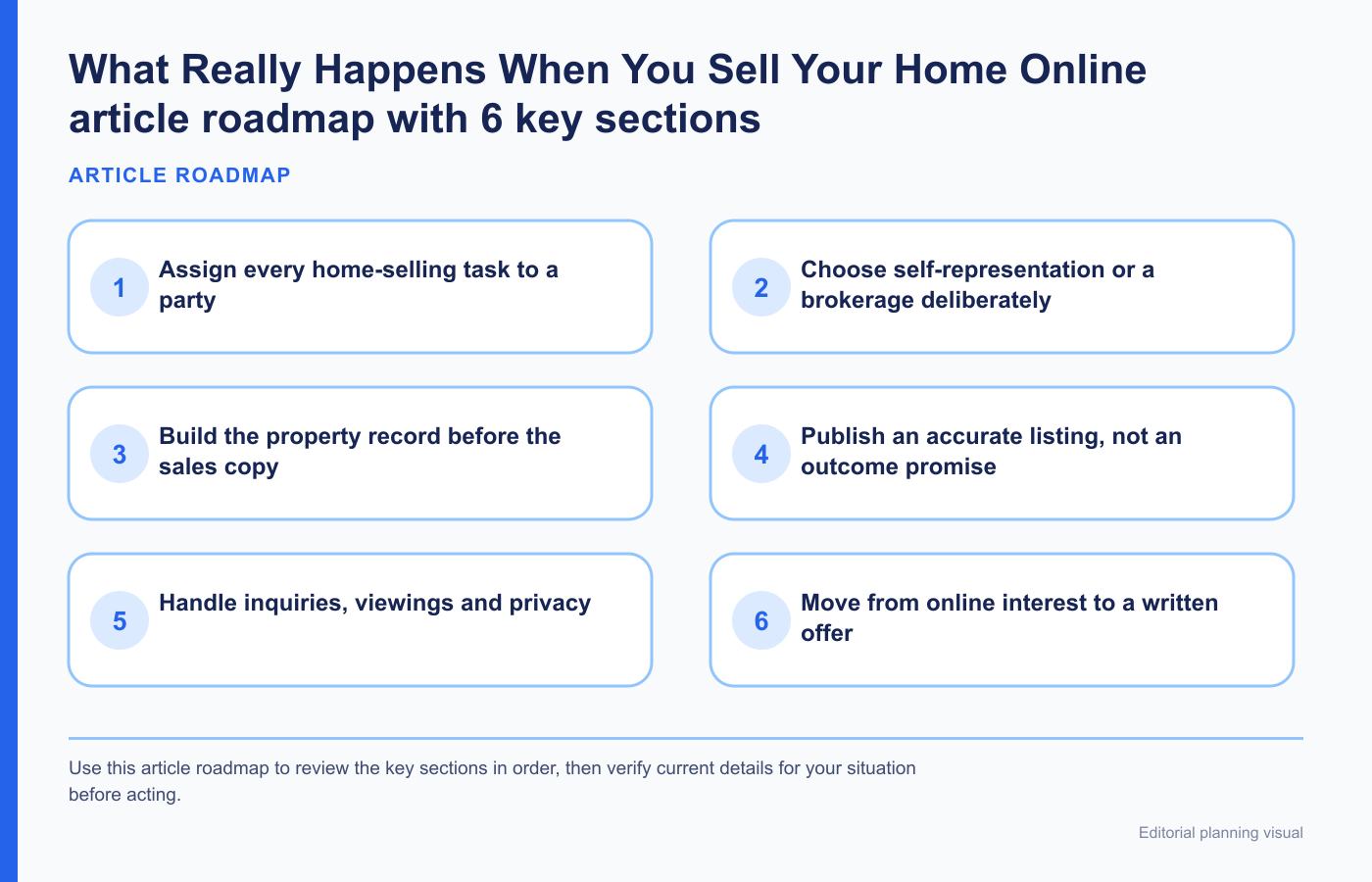
Choose self-representation or a brokerage deliberately
Real-estate regulation differs across Canada. In Ontario, RECO explains that a self-represented party makes their own decisions and does not receive the duties an agent owes to a client. An agent representing the buyer works for the buyer. RECO recommends independent professional advice when proceeding without representation.
If you engage a brokerage, read the agreement. RECO says Ontario representation agreements can address purpose, duration, remuneration and holdover. Ask which marketing, showing, negotiation and document services are included, and how any online platform fits the agreement.
Build the property record before the sales copy
Collect ownership and title questions for the lawyer, tax and utility information, surveys if available, permits and records for relevant work, equipment or rental agreements, condominium documents where applicable, known defects and inclusion decisions. Keep sensitive records out of the public listing.
RECO explains that property information statements may be prepared for different purposes and can address defects and renovations based on seller knowledge. Disclosure obligations are fact-specific. Discuss the property and intended statement with the appropriate lawyer and representative; do not copy a prior listing or let generated text invent facts.
Publish an accurate listing, not an outcome promise
Decide what the listing will show: property type, location, dimensions, features, condition, inclusions, asking strategy, images and showing process. Verify measurements and state their basis. Identify virtual staging or altered images clearly. Remove private documents, security details and personal information from photos.
- Draft from the verified property record.
- Review every image and field before publication.
- Save the approved version and date.
- Correct errors across every channel promptly.
- Track where inquiries originate without publishing personal data.
Houseup’s listings route shows the public discovery context. A live listing remains the seller’s representation of a changing property and must be kept current.
Handle inquiries, viewings and privacy
Define who answers questions, qualifies access requests, schedules viewings and records consent. Protect keys, lockbox codes, alarm information and occupant schedules. Decide what proof is reasonably required and how personal information is stored. Read the platform’s privacy policy and do not move sensitive conversation to an unexpected channel without checking it.
A direct message is not proof of buyer identity or ability to close. Use a consistent process and involve the appropriate professionals before accepting claims or funds.
Move from online interest to a written offer
Likes, saves and inquiries are not offers. A written offer may include price, deposit, conditions, closing date, inclusions, representations and other obligations. Review the entire document, identify questions for the lawyer and decide based on the seller’s priorities and risk—not the headline number alone.
- Confirm the offer version and expiry.
- Compare deposit, conditions, dates and inclusions.
- Understand requested representations and warranties.
- Document acceptance, rejection or counteroffer instructions.
- Keep signed copies and a communication record.
Closing still requires legal and practical coordination
After acceptance, conditions, inspections, financing, document delivery and other obligations may remain. The lawyer manages transaction-specific legal work and title transfer. The seller still plans moving, agreed property condition, final access, keys, utility information and included items.
An online “sold” label is not itself a legal closing or release of funds. Do not announce completion before the responsible professionals confirm it.
Know what an online platform cannot establish alone
- The legal value or condition of the property.
- The seller’s disclosure obligations.
- A buyer’s ability to close.
- The best price or offer strategy.
- Professional credentials outside a documented verification scope.
- Tax treatment, title, zoning or permit status.
- Sale timing, savings or transaction outcome.
Common online home selling mistakes
- Listing before choosing roles: responsibility becomes unclear.
- Using generated facts: verify every claim.
- Publishing private information: separate public marketing from adviser records.
- Treating messages as qualified offers: require the proper written process.
- Skipping legal advice: templates are not transaction-specific counsel.
- Assuming a directory is an endorsement: verify providers independently.
- Choosing by price alone: compare all offer terms.
- Announcing too early: accepted and closed are different states.
Frequently asked questions
Can I sell my home without a real-estate agent?
Self-representation may be possible, but rules and risks vary. Understand which tasks and advice you must arrange and engage a lawyer early.
Does an online listing platform verify the property?
Verification practices vary. Ask exactly what the platform checks and independently verify facts central to the transaction.
Can I use an online home value as the asking price?
It can be one input, but condition, comparables, legal use and strategy require property-specific analysis. It is not automatically an appraisal or guaranteed sale price.
When is a home actually sold?
Transaction stages include offer acceptance, condition handling and legal closing. Ask the lawyer when the transaction has legally completed.
Use the platform as a workflow, not a substitute
A clear online sale makes responsibility more visible. The seller, platform and professionals should each have a defined role, evidence and handoff.
Sources reviewed
- Houseup homepage, listings, professionals, terms and privacy — first-party platform context only.
- RECO self-representation risks — Ontario representation context.
- RECO property information statements — statement purpose and disclosure context.
- RECO brokerage contracts — Ontario agreement context.